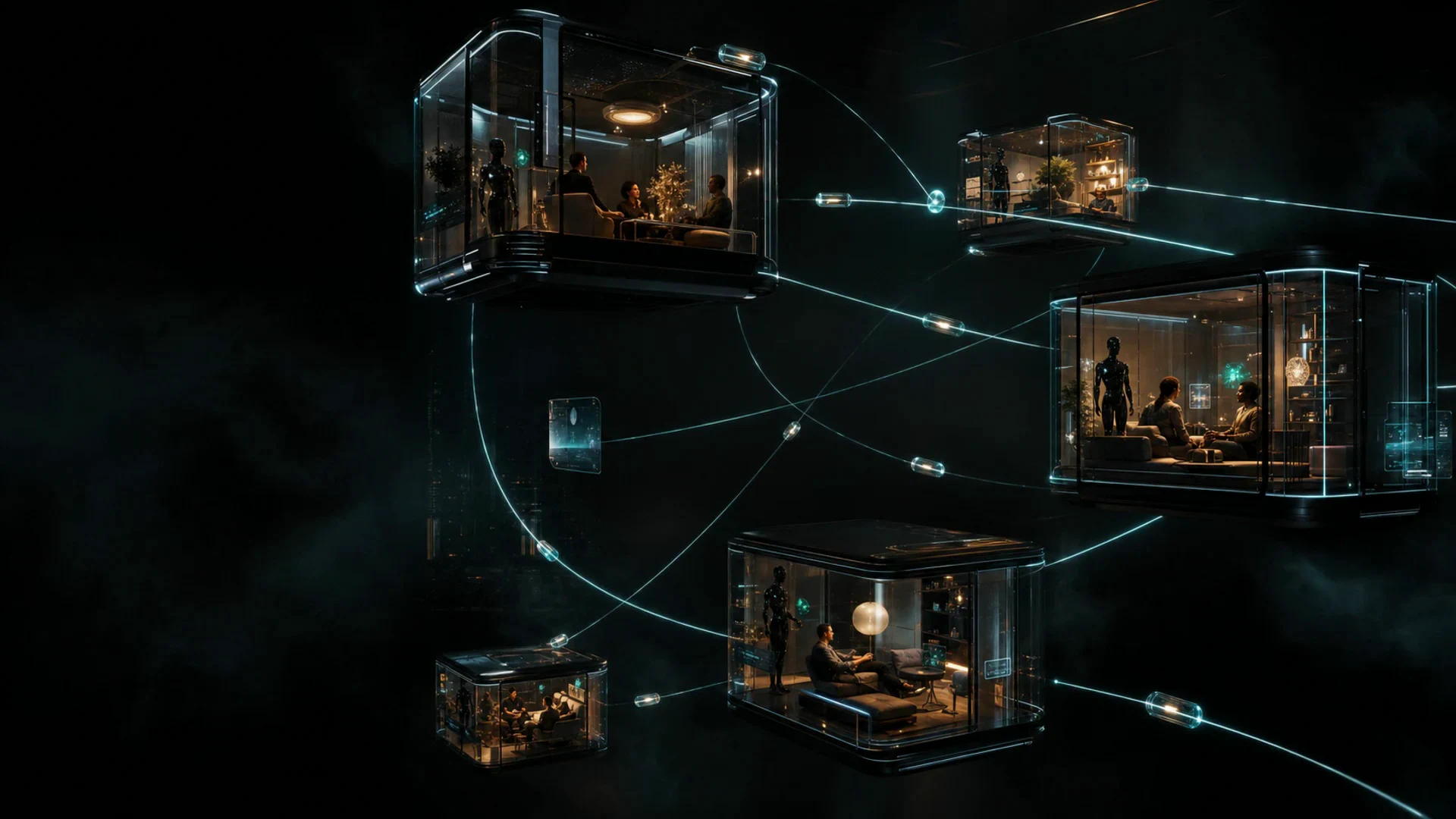
Private social infrastructure / owner controlled
A private social network, built from nodes you own.
Owner-controlled social communication across independently operated Matrix nodes. No central platform owns the empty space between them.
Drag horizontally to explore; swipe vertically to continue.
Your conversations have a home you control.
Dirextalk puts the domain, service, and data plane under the node operator's control. You choose where the node runs and who can enter its rooms.

Your domain. Their domain. One conversation.
Independent nodes communicate through Matrix federation. People can participate from separately operated domains while each operator remains responsible for their own node.
Bring Agents into a room—not into your entire life.
Supported local Agent runtimes connect through Dirextalk connect and the message server's remote HTTP MCP endpoint. Room membership and MCP block lists define access boundaries; they are not claims of encryption.
From domain to live node.
Follow the path from domain to cloud node, mobile client, and Agent bridge. The public server, deployer, and connect repositories show the parts that are ready to inspect and use.
Product surface / 06
Infrastructure becomes a place people can actually use.
- 01Direct conversationsPrivate chats and shared media
- 02GroupsRooms for people you choose
- 03ChannelsPosts and conversation together
- 04CallsPermission-aware voice and video
- 05Agent roomsRoom-scoped local runtimes
- 06Owner boundaryYour domain and data plane
Inspectable source / 07
Public where the path is ready. Explicit where it is not.
The Matrix-backed communication service and product contracts.
PublicDirextalk deployerDeployment skillProvision, verify, resume, and remove an owner-controlled node.
PublicDirextalk connectAgent bridgeConnect supported local Agent runtimes to private rooms through remote HTTP MCP.
Website deployment tooling; not yet anonymously public.
Host update and rollback tooling; not yet anonymously public.
The Dirextalk client; public source address is not yet available.
This website; no external repository has been published yet.
Practical boundaries / 08
Clear answers before you bring a node online.
01What does “private” mean for Dirextalk?
It means ownership and boundaries: a node operator chooses the domain and infrastructure, owns the data plane, and controls room and Agent access. It is not a blanket promise about every room's encryption configuration.
02How do independently operated nodes communicate?
They communicate through Matrix federation. Participating domains exchange room events while each node remains under its own operator's control.
03Is this only infrastructure?
No. Dirextalk is a social product for direct chats, groups, channels, media, contacts, search, notifications, voice and video surfaces, and Agents. Call availability depends on platform permissions and WebRTC support.
04How do local Agents join a room?
Supported local runtimes use Dirextalk connect to reach the message server's remote HTTP MCP endpoint. Room membership and MCP block lists set the access boundary.
05Which parts can I inspect today?
The message server, deployer, and Dirextalk connect repositories are intentionally public. Links for the web deployer, updater, Flutter client, and this site remain inactive until public addresses are available.
Private by boundary. Social by design.
A node is a place for people, not just infrastructure: direct chats, groups, channel posts and chat, media, contacts, search, notifications, calls, and Agents share one social product.